*on 5th June,
movienights & the pulling a dead horse evening
will be part of the program of the cross-disciplinary workshop:
Moving in Free Zones (Mfz)
31th May - 10th June 2007
organized by iStrike foundation in collaboration with Spacelab/Urban Body TU-Delft
venue: c/o foundation B.a.d, Talingstraat 5, Charlois, Rotterdam.
info: www.istrike.net
www.foundationbad.nl
Wednesday, May 16, 2007
Sunday, May 13, 2007
5th June / Sympathy for the devil (1968)
a film by Jean-Luc Godard
Godard's documentation of late 1960's western counter-culture, examining the Black Panthers, referring to works by LeRoi Jones and Eldridge Cleaver. Other notable subjects are the role of the media, the mediated image, A growing technocratic society, Womens Liberation, the May revolt in France and the power of language. Cutting between 3 major scenes, including the Rolling Stones in the studio, the film is visually intercut with Eve Democracy (Wiazemsky) using graffiti which amalgamates organisations, corporations and ideologies. Godard also examines the role of the revolutionary within western culture. Although he believes western culture needs to be destroyed, it can only be done so by the rejection of intellectualisation. "There is only one way to be an intellectual revolutionary, and that is to give up being an intellectual"
Written by {gary.elshaw@vuw.ac.nz}
Godard's documentation of late 1960's western counter-culture, examining the Black Panthers, referring to works by LeRoi Jones and Eldridge Cleaver. Other notable subjects are the role of the media, the mediated image, A growing technocratic society, Womens Liberation, the May revolt in France and the power of language. Cutting between 3 major scenes, including the Rolling Stones in the studio, the film is visually intercut with Eve Democracy (Wiazemsky) using graffiti which amalgamates organisations, corporations and ideologies. Godard also examines the role of the revolutionary within western culture. Although he believes western culture needs to be destroyed, it can only be done so by the rejection of intellectualisation. "There is only one way to be an intellectual revolutionary, and that is to give up being an intellectual"
Written by {gary.elshaw@vuw.ac.nz}

Monday, April 02, 2007
PLAYTIME (1967, France)


Playtime is French director Jacques Tati's fourth major film.
In Playtime, Tati's character, Monsieur Hulot, and a group of American tourists lose themselves in a futuristic glass and steel Paris, where only human nature and a few hints of old Paris briefly breathe life into the city. New technologies, billed as conveniences, are represented as merely complicating life and an interference to natural human interaction.
The film is famous for its enormous, specially constructed set and background stage, known as 'Tativille', which cost enormous sums to build and maintain. The set required 100 construction workers to build it, and its very own power plant to function. Storms, budget crises, and other disasters stretched the shooting schedule to three years. Budget overruns forced Tati to take out large loans and personal overdrafts to cover ever-increasing production costs.
Tuesday, March 27, 2007
Coffee and Cigarettes

A Film by Jim Jarmusch (US 2003)
Coffee and Cigarettes is an 2003 independent film that consists of eleven short stories which share coffee and cigarettes as a common thread.
A comic series of short vignettes built on one another to create a cumulative effect, as the
characters discuss things as diverse as caffeine popsicles, Paris in the '20s, and the use of nicotine as an insecticide--all the while sitting around sipping coffee and smoking cigarettes. As director Jim Jarmusch delves into the normal pace of our world from an extraordinary angle, he shows just how absorbing the obsessions, joys and addictions of life can be, if truly observed.
cast: Roberto Benigni, Steven Wright, Iggy Pop, Joie Lee, Cinqué Lee,Steve Buscemi,Tom Waits,Joseph Rigano,
Vinny Vella, etc.
Monday, March 19, 2007
The Apple
A film by Samira Makhmalbaf
Iran 1997

The Apple is a stunning feature film debut from Samira Makhmalbaf, the 18-year-old daughter of Iranian filmmaker Mohsen Makhmalbaf. Her father is the director of films such as "Gabbeh," "Salaam Cinema," and "The Cyclist," but with "The Apple," the younger Makhmalbaf definitively establishes her own voice. Richly allusive and beautifully photographed, "The Apple" follows the aftermath of a real-life situation in which a father had kept his two daughters confined to their home since birth. When neighbors reported the situation to the welfare authorities in Teheran, the daughters, who are slightly retarded, were removed from the home and returned to their parents only on the condition that the father allow the two to leave home and explore the outside world.
Iran 1997

The Apple is a stunning feature film debut from Samira Makhmalbaf, the 18-year-old daughter of Iranian filmmaker Mohsen Makhmalbaf. Her father is the director of films such as "Gabbeh," "Salaam Cinema," and "The Cyclist," but with "The Apple," the younger Makhmalbaf definitively establishes her own voice. Richly allusive and beautifully photographed, "The Apple" follows the aftermath of a real-life situation in which a father had kept his two daughters confined to their home since birth. When neighbors reported the situation to the welfare authorities in Teheran, the daughters, who are slightly retarded, were removed from the home and returned to their parents only on the condition that the father allow the two to leave home and explore the outside world.
Monday, March 12, 2007
Samaritan Girl (Samaria)
(2004 South Korea)
A film by Kim Ki-duk


Yeo-jin and Jae-yeong are two teenage girls who are trying to earn money for a trip to Europe. To reach this end, Jae-yeong is prostituting herself while Yeo-jin acts as her pimp, setting her up with the clients and staying on guard for the police.
As with many other films by Kim Ki-duk,(Spring, Summer, Autumn, Winter... and Spring, 2003) Samaritan Girl wasn't a box office success in its home country, but was better received overseas. In the film's first large scale showing it won the Silver Bear, the second place award at the Berlin International Film Festival in 2004 After this, it became a sought after film for other international film festivals.
A film by Kim Ki-duk


Yeo-jin and Jae-yeong are two teenage girls who are trying to earn money for a trip to Europe. To reach this end, Jae-yeong is prostituting herself while Yeo-jin acts as her pimp, setting her up with the clients and staying on guard for the police.
As with many other films by Kim Ki-duk,(Spring, Summer, Autumn, Winter... and Spring, 2003) Samaritan Girl wasn't a box office success in its home country, but was better received overseas. In the film's first large scale showing it won the Silver Bear, the second place award at the Berlin International Film Festival in 2004 After this, it became a sought after film for other international film festivals.
Sunday, March 04, 2007
Vivre sa Vie
(1962 France)
Directed by Jean-Luc Godard

Original title:
Vivre sa Vie: Film en Douze Tableaux, or "To Live One's Life: A Film in Twelve Tableaux."
Anna Karina, Godard's then wife, stars as Nana, a young Parisian woman who abandons her marriage and a child in order to pursue a career as an actress. Faced with financial troubles she drifts into prostitution. Nana believes she makes this choice of her own free will, but the film emphasises the social structure that forces the poor into such situations, and builds to a tragic conclusion. Rather than glamorizing prostitution Godard analyses it from a sociological perspective. In fact, one of the film's original sources is a study of contemporary prostitution, Où en est la prostitution by Marcel Sacotte.
Vivre sa Vie catalogues the nature of modernity. In particular it is saturated with quotations from, and observations about, the popular or consumerist culture of Godard's Paris.
Directed by Jean-Luc Godard

Original title:
Vivre sa Vie: Film en Douze Tableaux, or "To Live One's Life: A Film in Twelve Tableaux."
Anna Karina, Godard's then wife, stars as Nana, a young Parisian woman who abandons her marriage and a child in order to pursue a career as an actress. Faced with financial troubles she drifts into prostitution. Nana believes she makes this choice of her own free will, but the film emphasises the social structure that forces the poor into such situations, and builds to a tragic conclusion. Rather than glamorizing prostitution Godard analyses it from a sociological perspective. In fact, one of the film's original sources is a study of contemporary prostitution, Où en est la prostitution by Marcel Sacotte.
Vivre sa Vie catalogues the nature of modernity. In particular it is saturated with quotations from, and observations about, the popular or consumerist culture of Godard's Paris.
Monday, February 19, 2007
Menschen am Sonntag

PEOPLE ON SUNDAY / Menschen am Sonntag (1930, Germany)
Directed by Curt Siodmak & Robert Siodmak
Interesting, complex, and perplexing documentary / film.
A tale of five young Berliners - a taxi driver, a travelling wine dealer, a record shop sales girl, a film extra and a model - spending a typical Sunday. In this vivid snapshot of Berlin life, a trip to the countryside reveals the flirtations, rivalries, jealousies, and petty irritations common to any group outing. All too soon it is the end of the day, and the prospect of Monday looms, and the return to the weekday routine.
People on Sunday marked the start of the film careers of six cinéastes who would go on to great international successes: Billy Wilder, Robert and Curt Siodmak, Edgar G Ulmer, Eugen Schüfftan and Fred Zinneman.
Tuesday, February 06, 2007
Short Films

L'Homme Sans Tête ( The Man Without a Head)
France - Argentina 2003 / 18 min
A film by Juan Diego Solanas
A shy man lives in the big city alone. When he gets two free tickets to the ball he invites a girl he has had his eye on for quite a while. She agrees to meet him later and go as his date. He dresses well but he feels rather self-conscious because he has no head – and never has. He sets out to buy some flowers and a head before meeting his date, but finding a head that suits him is no easy task.
awards: 5 wins & 1 nomination ( more )

Bara Prata Lite (TALK)
Sweden 1997 / 14 min
A film by Lukas Moodysson
Birger is old and retired from work. Still, he goes back to work since he has nothing else to do. Back home he gets a rare visitor: a girl from Hare Krishna recruiting new members. But his need for human contact proves to be to overwhelming for the girl...
Tuesday, January 30, 2007
New Location
movienights &
the Pulling a Dead
Horse evenings
are moving to
a new location:
Studio Pompstraat 44c
Rotterdam.
Pulling a Dead Horse evenings
find his name in the dutch expression:
'Trekken aan een dood paard'
which means putting effort into something that is doomed to become a failure.
the Pulling a Dead
Horse evenings
are moving to
a new location:
Studio Pompstraat 44c
Rotterdam.
Pulling a Dead Horse evenings
find his name in the dutch expression:
'Trekken aan een dood paard'
which means putting effort into something that is doomed to become a failure.
Monday, January 22, 2007
Tristana (Luis Buñuel, 1970)

1970-Spain/France/Italy
A film by Luis Buñuel based on a novel by Benito Pérez Galdós, with Catherine Deneuve and Fernando Rey.
Luis Buñuel's Tristana is a surreal criticism of Catholicism and the modern world, told through the story of the title character, who is portrayed by Catherine Deneuve. Tristana is a young Spanish woman left to the care of Don Lope (Fernando Rey), the protective but impoverished aristocrat. Don sells his possessions to avoid manual labor and champions the causes of the dispossessed and downtrodden of society. He takes advantage of the vulnerable Tristana, who leaves him when she falls in love with Horacio (Franco Nero). Unable to commit to him, she returns to Don Lope when she falls ill. He asks for her hand in marriage, and she accepts after losing her leg to cancer. She chooses to remain in a passionless union rather than be subject to the harsh realities of a society that refuses to change to the needs of women. Taken from the novel by celebrated author Benito Perez Galdos, the film -- wherein director Buñuel takes his usual jabs at religion and politics -- is a tribute to the author on the 50th anniversary of his death. ~ Dan Pavlides, All Movie Guide.
Tuesday, January 09, 2007
Amarcord (Federico Fellini, 1973)
movienights Tuesday 16th January

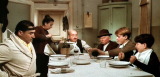
Federico Fellini's warmly nostalgic memory piece examines daily life in the Italian village of Rimini during the reign of Mussolini in the 3o's, and won the 1974 Academy Award as Best Foreign Film. The film's greatest asset is its ability to be sweet without being cloying, due in great part to Danilo Donati's surrealistic art direction and to the frequently bawdy injections of sex and politics by screenwriters Fellini and Tonino Guerra. Fellini clearly has deep affection for the people of this seaside village, warts and all, and communicates it through episodic visual anecdotes which are seen as if through the mists of a favorite dream, playfully scored by Nino Rota and lovingly photographed by Giuseppe Rotunno. Amarcord is a rich gem of a film which only improves on subsequent viewings.
Amarcord is the phonetic translation of the Italian words "Mi Ricordo" (I remember) as pronounced in the dialect of Emilia-Romagna, the birthplace of director Federico Fellini and the setting of this wonderful film. Little surprise, then, that it is a poignant and bawdy semi-autobiographical coming-of-age tale, with an ethereal, dreamlike quality that combines sharply drawn memories with vividly engaging fantasy.
Robert Firsching, All Movie Guide
Federico Fellini's warmly nostalgic memory piece examines daily life in the Italian village of Rimini during the reign of Mussolini in the 3o's, and won the 1974 Academy Award as Best Foreign Film. The film's greatest asset is its ability to be sweet without being cloying, due in great part to Danilo Donati's surrealistic art direction and to the frequently bawdy injections of sex and politics by screenwriters Fellini and Tonino Guerra. Fellini clearly has deep affection for the people of this seaside village, warts and all, and communicates it through episodic visual anecdotes which are seen as if through the mists of a favorite dream, playfully scored by Nino Rota and lovingly photographed by Giuseppe Rotunno. Amarcord is a rich gem of a film which only improves on subsequent viewings.
Amarcord is the phonetic translation of the Italian words "Mi Ricordo" (I remember) as pronounced in the dialect of Emilia-Romagna, the birthplace of director Federico Fellini and the setting of this wonderful film. Little surprise, then, that it is a poignant and bawdy semi-autobiographical coming-of-age tale, with an ethereal, dreamlike quality that combines sharply drawn memories with vividly engaging fantasy.
Robert Firsching, All Movie Guide
Subscribe to:
Posts (Atom)
